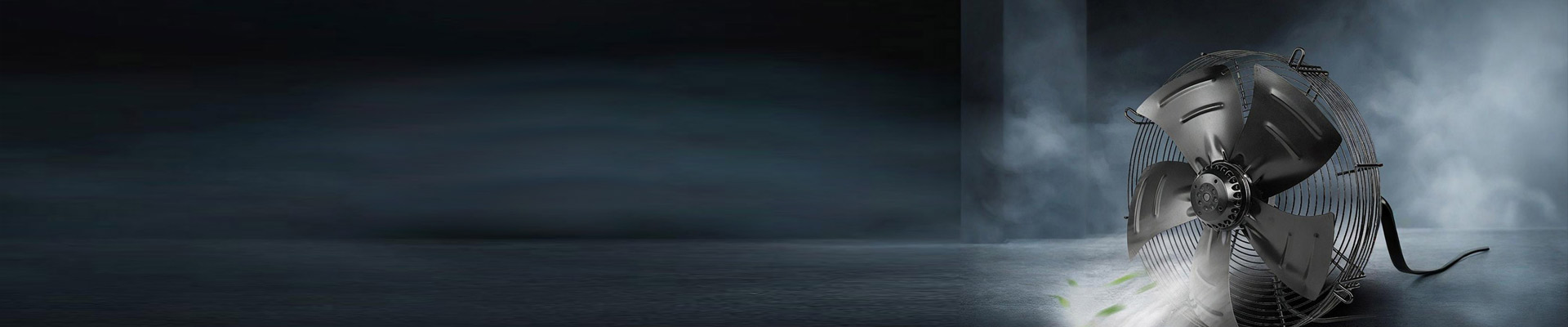
Maintenance and Fault Causes of Outer Rotor Air Conditioning Fans
Outer rotor centrifugal air conditioning fans feature large air volume, low noise, compact structure, sturdiness and durability, elegant appearance, and convenient installation and operation. They are widely applicable to various air conditioning units, air curtains, cooling and heating fan units, as well as indoor ventilation for industrial and mining enterprises and public places.
The fan is designed to deliver air and other non-combustible, harmless gases. The conveyed gas must be free of granular substances, with a dust content not exceeding 150mg/m³.
Maintenance Regulations
1. The outer rotor air conditioning fan shall be operated and maintained by designated professional personnel only.
2. Do not operate the fan with existing faults or abnormal conditions.
3. Regularly clean internal dust, especially dirt and impurities on the impeller, to prevent rusting and dynamic balance deviation.
4. Cut off the power supply and stop the fan completely before any maintenance work.
5. Regularly check the sensitivity of thermometers and oil level gauges.
6. Replace lubricating oil every 3 to 6 months under normal operating conditions. Lubricating oil must be replaced after each disassembly and maintenance.
Main Faults and Causes
1. Severe Vibration of Bearing Housing
① Misalignment between fan shaft and motor shaft, or incorrect coupling installation;
② Friction between the casing/inlet and the impeller;
③ Insufficient rigidity of the fan foundation;
④ Loose impeller rivets or deformed impeller;
⑤ Loose fit between impeller hub and shaft, or loose coupling bolts;
⑥ Loose connecting bolts between casing and support, bearing housing and support, as well as bearing housing cover and base;
⑦ Improper installation of fan inlet and outlet pipelines;
⑧ Unbalanced rotor caused by blade wear.
2. Excessively High Bearing Temperature
① Severe vibration of the bearing housing;
② Inferior or deteriorated lubricating grease mixed with excessive dust, sediment and impurities;
③ Excessively tight or loose fastening force of bolts connecting bearing housing cover and base;
④ Skewed installation of shaft and rolling bearing, or misalignment of front and rear bearings;
⑤ Damaged rolling bearing.
3. Excessive Motor Current or Overhigh Motor Temperature
① Inlet pipeline gate or throttle valve not fully closed during startup;
② Actual airflow exceeding the rated value;
③ Excessively high density or viscous substances contained in the conveyed gas;
④ Low motor input voltage or single-phase power failure;
⑤ Misaligned coupling connection, overly tight rubber ring or uneven clearance;
⑥ Abnormal operation caused by severe vibration of the bearing housing.
Operation and Performance Introduction of Centrifugal Fans
Even if users select high-quality centrifugal fans, failure to operate the equipment in strict accordance with the operating instructions during use will compromise fan performance and shorten the service life of centrifugal fans, resulting in substantial losses for users.
The service life and operating condition of a fan start with correct startup. Startup failure or excessively long startup time may occur due to various reasons, and targeted troubleshooting solutions are listed as follows:
- If the motor is under load failure, check the setting value of the safety mechanism.
- If the motor rated power is insufficient, replace the motor with a suitable one.
- If the startup procedure is incorrect, adjust the startup equipment accordingly.
- If excessive power consumption occurs during startup, verify whether the gas flow control mechanism is in the fully closed position before startup.
- If the rotor is stuck, manually rotate the fan impeller to inspect and identify the causes such as friction or internal foreign obstacles.
- If the voltage at the motor wiring terminal is too low, check the power line voltage. Replace with thicker power lines if serious voltage loss occurs.
Users may often notice unnecessary energy consumption during fan operation. This issue is mainly caused by gas leakage circulation between the front cover and the collector. For centrifugal fans, standard gaps shall be maintained between the front cover and the collector, as well as between the casing and the rotating shaft. This standard structural design ensures stable and reliable fan rotation and effectively reduces invalid energy loss caused by airflow leakage.
The centrifugal fans manufactured by Xinchang Bolete Machinery Co., Ltd. have been continuously optimized and upgraded over more than a decade. The fan housing is made of non-spangle environmental galvanized steel sheets from Shougang Group. All components are molded with precision dies and assembled on standardized production lines. Advanced manufacturing processes are adopted for core components, including impeller rolling, volute seaming, and TOX riveting connection.
Featuring a reasonable structural design, our centrifugal fans deliver outstanding advantages including low noise, high efficiency, long service life, compact size and safe and reliable operation.
With the advancement of technology, outer rotor air conditioning fans have been widely applied in various industries. Vibration is an inevitable common issue during fan operation, which may trigger a series of equipment faults. The main causes of fan vibration are summarized into the following five categories:
1. Design Factors
The design of outer rotor air conditioning fans shall be determined based on actual operating conditions, including service environment, temperature, air volume, air pressure and working medium. Unreasonable model selection and design by manufacturers will lead to poor dynamic performance and operational vibration. Common problems include improper fan design, unsatisfactory dynamic characteristics, structural irrationality and stress concentration. In addition, if the designed operating speed is close to or within the critical speed range, or the thermal expansion coefficient is inaccurately calculated to cause poor thermal alignment, severe operational vibration will occur.
2. Manufacturing Factors
Manufacturing quality directly determines the operating stability of outer rotor air conditioning fans. Vibration faults may result from insufficient machining precision of components, inferior raw materials with inadequate strength and manufacturing defects. Besides, failure to meet technical standards for rotor dynamic balance will also cause persistent fan vibration during operation.
3. Installation and Maintenance Factors
Installation accuracy is critical to the stable operation of fans. Substandard installation will seriously damage the operating performance of equipment. Major influential factors include improper mechanical installation, component misalignment and excessive preload, poor shaft system alignment, and inaccurate adjustment of mechanical geometric parameters such as fitting clearance, interference magnitude and relative position. Moreover, improper long-term storage of rotors will impair dynamic balance accuracy, and non-standard maintenance will destroy the original fitting precision and structural coordination of the equipment, inducing vibration failure.
4. Operation Factors
Daily maintenance and standardized operation decisively affect fan operating quality. Vibration problems will occur if technical parameters such as medium temperature, pressure, flow rate and load deviate from design values, leading to abnormal operating conditions. Running the fan at over-speed or over-load will alter its inherent operating characteristics. In addition, poor lubrication or cooling performance, local rotor damage and scaling, improper operation during startup, shutdown and speed adjustment, uneven thermal expansion, and excessive residence time in the critical speed range will all trigger continuous fan vibration.
5. Equipment Aging Factors
All mechanical equipment has a limited service life, and performance degradation is inevitable after long-term operation. For outer rotor air conditioning fans, common aging problems include increased rotor deflection and degraded dynamic balance, local rotor damage, shedding or cracks, as well as component wear, pitting and corrosion. Aging of fitting surfaces leads to insufficient interference or loose connection, damaging fitting accuracy. Uneven settlement of the equipment foundation and deformation of the fan casing will also cause structural vibration of the whole machine.


 0575-86167222